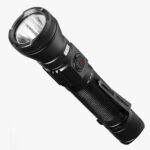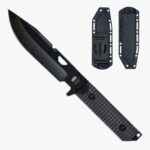
Every professional who works in unpredictable environments — whether in law enforcement, fire rescue, or security — knows that gear failure isn’t an inconvenience; it’s a liability. Tactical flashlights, radios, watches, and multitools are exposed to heat, dust, water, and impact daily. That’s where Ingress Protection (IP) ratings come in.
An IP rating tells you exactly how well a device’s housing protects its internal components from solid particles (like dust) and liquids (like rain or submersion). It’s a global standard that separates professional-grade equipment from hobby gear.
“Reliability is built, not claimed.” – Unknown engineer’s maxim, engraved on early test labs in Germany
When your mission doesn’t stop for the weather, understanding those two small letters – IP – can mean the difference between trusted equipment and failed support.
How to Read an IP Rating
The IP system (International Protection Marking, IEC standard 60529) uses two numbers:
- The first digit defines protection against solids — like dust, sand, or debris.
- The second digit defines protection against liquids — from dripping water to full submersion.
For example:
- IP44: Protected from solid objects >1 mm and water splashing from any direction.
- IP65: Dust-tight and resistant to low-pressure water jets.
- IP67: Dust-tight and can survive submersion in 1 meter of water for 30 minutes.
- IP68: Dust-tight and waterproof beyond 1 meter, depending on manufacturer testing.
Each number represents a controlled lab test, simulating what professionals experience in the field. It’s not marketing—it’s measurable performance.
“If you can’t measure it, you can’t improve it.” – Lord Kelvin
Real-World Meaning: Dust and Water Resistance in Action
Dust resistance is critical for desert and urban environments where fine particles infiltrate gear. Dust can ruin switches, clog vents, and degrade seals over time. For soldiers, it’s sand. For police, it’s road grit. For firefighters, it’s ash.
Water resistance matters equally. Rain, humidity, sweat, or submersion — each condition tests your gear’s design. A flashlight rated IP68 can survive being dropped in a puddle or a flood and still illuminate. A tactical radio at IP67 will keep transmitting even after being drenched by rain.
IP ratings ensure that tools perform when conditions collapse. That’s not luxury—it’s survival engineering.
The Limitations – What IP Ratings Don’t Cover
IP ratings aren’t the whole story. They don’t test for impact, vibration, or corrosion. That’s why tactical products often combine IP ratings with MIL-STD-810 (military testing standards).
For example, a device can be IP68 waterproof, but if it’s dropped from two meters onto concrete, and its internal frame cracks, the IP rating no longer applies.
Durability is multi-dimensional. IP defines sealing; military testing defines structural strength.
Together, they create what Saint Gear calls mission-grade reliability — gear designed for both environmental resistance and physical endurance.
“The strength of the wolf is the pack, and the strength of the pack is the wolf.” – Rudyard Kipling (In engineering terms: systems are only as strong as their weakest seal.)
How Professionals Can Choose the Right IP Rating
Not every role requires IP68. What matters is matching rating to mission:
- IP44–IP54: Indoor or low-exposure gear (office security, inspection work).
- IP65–IP67: Standard for most tactical or law enforcement operations.
- IP68: Ideal for high-exposure environments — flood zones, marine units, or outdoor rescue operations.
Firefighters, for example, face water, steam, and ash simultaneously. IP68 gear ensures reliability through every element. Meanwhile, police patrols benefit from IP65+ ratings for rain, impact, and urban conditions.
Choose by context, not by number inflation. Over-specifying can add weight and cost. Under-specifying can risk failure.
The Saint Standard: Built for Real Conditions
Every piece of Saint Gear hardware is selected or engineered with one rule: if it fails the environment, it fails the mission.
IP ratings are not just technical metrics — they represent respect for those who rely on their tools to protect, serve, and survive.
Whether it’s a flashlight, multitool, or tactical pen, the principle remains constant: gear should never need permission from the weather to perform.